
You and your union won 4.5% raises in the most recent round of contract negotiations.
For this round of negotiations, we agreed to work with management to implement the biweekly increment approach which our bargaining unit has used in the past. This only applies to full-time faculty. It’s a somewhat complex process to help faculty move more quickly up the salary scale in their current ranks. Here’s how it works.
The Short Version
This round of raises is being implemented with the biweekly increment formula. If you’re at the low end of your rank, this will help you move up your rank’s salary scale more quickly. The formula considers your rank, number of years in that rank, and the 4.5% overall wage increase that your union won. The biweekly increment raise will start with the first paycheck of the fall, on Sept. 18. Your union will negotiate a wage reopener in fiscal year 2028-29.
What happens if I’m at the top of my rank?
Faculty members who are already at the top of their ranks will get a 2.5% raise.
What happens if I’m not at the top of my rank?
For faculty who are lower in their rank, they will get a raise equivalent to 2% plus the biweekly increment. The median raise for members is 4.8%.
How does the raise go into effect?
The raises are added to your biweekly pay, which is why we call this a biweekly increment. Raises were implemented on July 1.
How is the biweekly increment determined?
We use a formula to determine this. Essentially, the formula is:
Rank multiplier (x) $4.13
How is the rank multiplier determined?
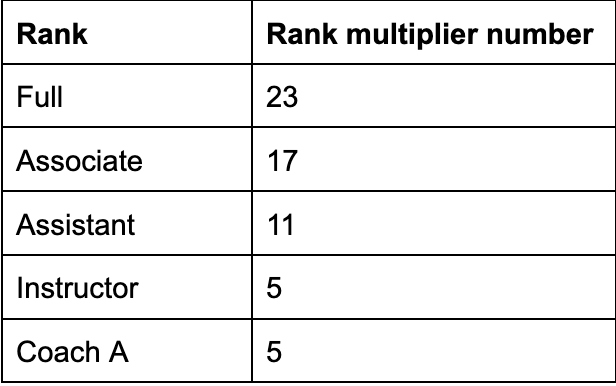
The rank multiplier is the number assigned to your rank (for example, the number for associate professors is 17) plus the number of years you have been in that rank.
``
Where is the $4.13 coming from?
This is the amount that gives us a general wage increase of 4.5% using the formula.
Example: Thus, the full formula for an associate professor would be:
Current salary + 2.5% raise + [(17 + number of years in rank) x ($4.13)]
The latter half of the formula is the biweekly increment.
Why do we do this?
When a faculty member is promoted to the next rank, they typically start at the bottom of that rank. When we win raises and apply that raise evenly to everyone, it moves the whole scale rather than helping faculty at the bottom of their rank move further up.
Think of it as a race. Without using the biweekly increment formula, we are simply moving the finish line for everyone who is not already at the end. It makes it nearly impossible for faculty to move up within their ranks prior to promotions.
The biweekly increment creates a more equitable spread of the wage increases and helps faculty who are lower in their ranks get closer to the finish line.
What comes next?
Your union will be negotiating a wage reopener in fiscal year 2028-29. We’ll provide more information about any changes as we get closer to those negotiations.